

AI Is Rerouting Financial Services: Time to Put Down MapQuest
Many gigs ago, I was a limousine driver. And not the black TLC sedan you’d typically take to and from the airport.
I drove one of those 12-20 passenger vehicles - the land barges you might see doing a K-turn from Manhattan’s Canal St onto Mulberry St. during prom and wedding seasons. [IYKYK]. A related aside: I was the [on-time, off-camera] driver for a bonkers episode of MTV’s documentary series True Life: I’m Getting Married.
Before every job, sitting on the passenger seat next to me, were my trusty, printed set of MapQuest directions telling me exactly how to get to where I was going. Remember MapQuest? Turn right in 1.7 miles. Left at the light. Proceed 4.3 miles. Miss a turn? Well, good luck. There was no recalculating. No friendly voice calmly suggesting an alternate route.
It was just me, my 30-foot white stretch Hummer [with the turning radius of the Exxon Valdez], a sheet of paper mapping my destination, and what felt like countless and [sometimes unruly] people beyond the partition wondering why we just looped the same jug handle twice.
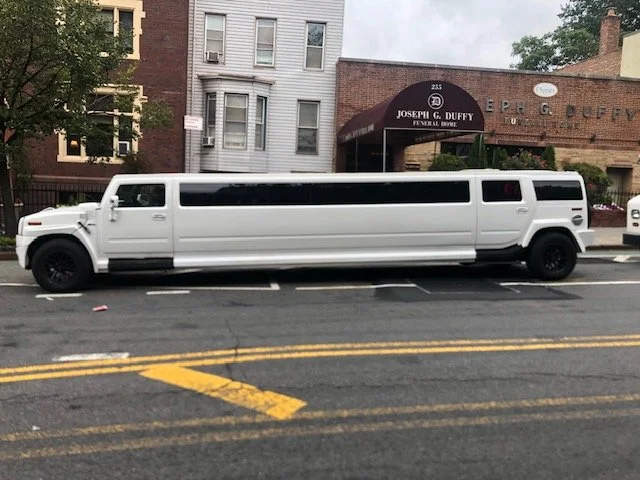
2027 Stretch Hummer Limousine
But here’s the thing. All of it worked because I figured it out, and didn’t know any better. That is until a better driver experience came along. I recall having the MapQuest directions on the dashboard [and hoping there weren’t two pages of street-turns or expressways] so I wouldn’t have to take my eyes off of the road. Stretch limos are basically relics now; today’s stretch job is a party bus, with a bathroom, and hands-free, mobile-phone driven, turn-by-turn directions.
So, while the directions have improved, I’m still responsible for where I’m going. However, am I willing to rethink where I’m headed?
Which brings me to the line I’ve shared in several financial advisory trainings, and one that remains top-of-mind for me professionally: What got you here isn’t going to get you there. That line is borrowed from executive coach and author Marshall Smith [with Mark Reiter] and his still ever-so-timely book: “What Got You Here Won’t Get You There.”
I’ve been thinking about that lately because, in a way, financial services is having its own MapQuest moment.
AI is changing how financial professionals prepare, learn, communicate and grow. It’s changing how managers coach them. And it’s certainly changing how those of us who consult, train and strategize alongside them do our jobs.
Growth and development tends to inhabit that intimidating, imperceptible and non-linear space between who you are and who you’re capable of becoming. Sometimes people don’t see the gap. Sometimes they see it and intentionally don’t want to cross it. And sometimes they need someone standing beside them saying, I know this feels uncomfortable. Keep going. Lately, it has caused me to re-route my own personal and professional development.
My most recent gig has always centered on helping financial professionals and the people who develop them get better at the very human parts of this business: conversations, relationships, confidence, communication and growth.
“The more powerful AI becomes, the more important the human on the other side of it becomes.”
AI hasn’t changed that mission. It has changed what’s possible. So, increasingly, my work is bringing the two together: building customized, AI-enabled coaching and development experiences that give financial professionals a place to practice, get feedback, get uncomfortable and get better.
That is not instead of human coaching, but rather in support of it. Sometimes development happens in a meeting with a great coach. Sometimes it happens on a random Tuesday night at 9:17pm, when you finally decide to practice the conversation you’ve been avoiding.
Here is a recent email testimonial I received from one of the advisors I have been working with.
“Adam,
“The coffee meeting went great today! Should be a good referral source, and we are looking to set up some time for him personally to rollover an old 401k.
The AI role-play we modeled using his profile information helped me ask relevant questions and highlight similarities in the markets our businesses are in. Looking to build off this, and thanks again for your help!”
That’s where AI gets interesting to me. We can practice conversations before they happen. Identify blind spots faster. Personalize development. Turn yesterday’s coaching moment into tomorrow morning’s practice.
Here’s the irony, however; the more powerful AI becomes, the more important the human on the other side of it becomes.
AI can illuminate the distance between here and there, but somebody still has to help us recognize that the old directions aren’t going to get us where we want to go.